Imagine one insulin parcel leaving a pharmacy in Dubai at 2 pm in July. It travels twenty minutes, waits two minutes at a lift, and ends up in a customer’s hand. Nothing dramatic happens, and yet the parcel can still fail, because the risk is spread across five small moments.
This guide follows that parcel from the pharmacy fridge to the customer’s kitchen. At each checkpoint, we look at what can go wrong and how a gel ice pack helps or hurts.
This is general packaging guidance, not medical advice. Follow the storage instructions on the product label and the requirements of your local health authority.
First, the target
Many refrigerated medicines, including most unopened insulin, are labelled for 2 °C to 8 °C. The band cuts both ways. Heat can weaken a product, and freezing can damage it for good. If insulin has frozen, it should not be used, even if it looks normal once thawed.
So the pack’s job isn’t to make things as cold as possible. It’s to keep the parcel inside a narrow band for the whole trip.
Checkpoint 1: The pharmacy fridge to the packing bench
The clock starts when the medicine leaves the fridge, not when the van leaves the car park.
- Pack from the fridge, not the shelf. A pack can only hold a temperature, it can’t do the original cooling.
- Keep the bench time short. Prepare the box and packs first, then take the medicine out last.
- Don’t pack a parcel hours before the rider arrives. Pack close to departure.
Checkpoint 2: Preparing the gel pack
This is where most medicine parcels go wrong, and it’s the opposite of what happens with food.
A gel ice pack kept in a freezer is far colder than 2 °C. Placed against a medicine box, it can pull the surface below the safe range while the rest of the parcel looks fine.
Three ways to manage it:
- Use a barrier. A layer of card, foam or paper between pack and medicine is the simplest fix.
- Condition the pack. Some teams let a frozen pack sit at room temperature briefly so its surface isn’t far below freezing. The right time depends on your box, so test it.
- Ask about chilled packs. For products that must never freeze, a pack stored in a fridge holds a gentler temperature than one from a freezer.
Whichever you choose, do it the same way every time. A routine you can repeat is more reliable than a clever one you can’t.
Checkpoint 3: Inside the bag
Layout decides whether the cold reaches the product evenly.
Put a barrier layer down first, then the medicine, then another barrier on top. Place the packs outside the barriers: one above and one below for a small parcel, more along the sides for a bigger one. Fill any empty space with paper so warm air has nowhere to collect.
Pick the format that fits the parcel:
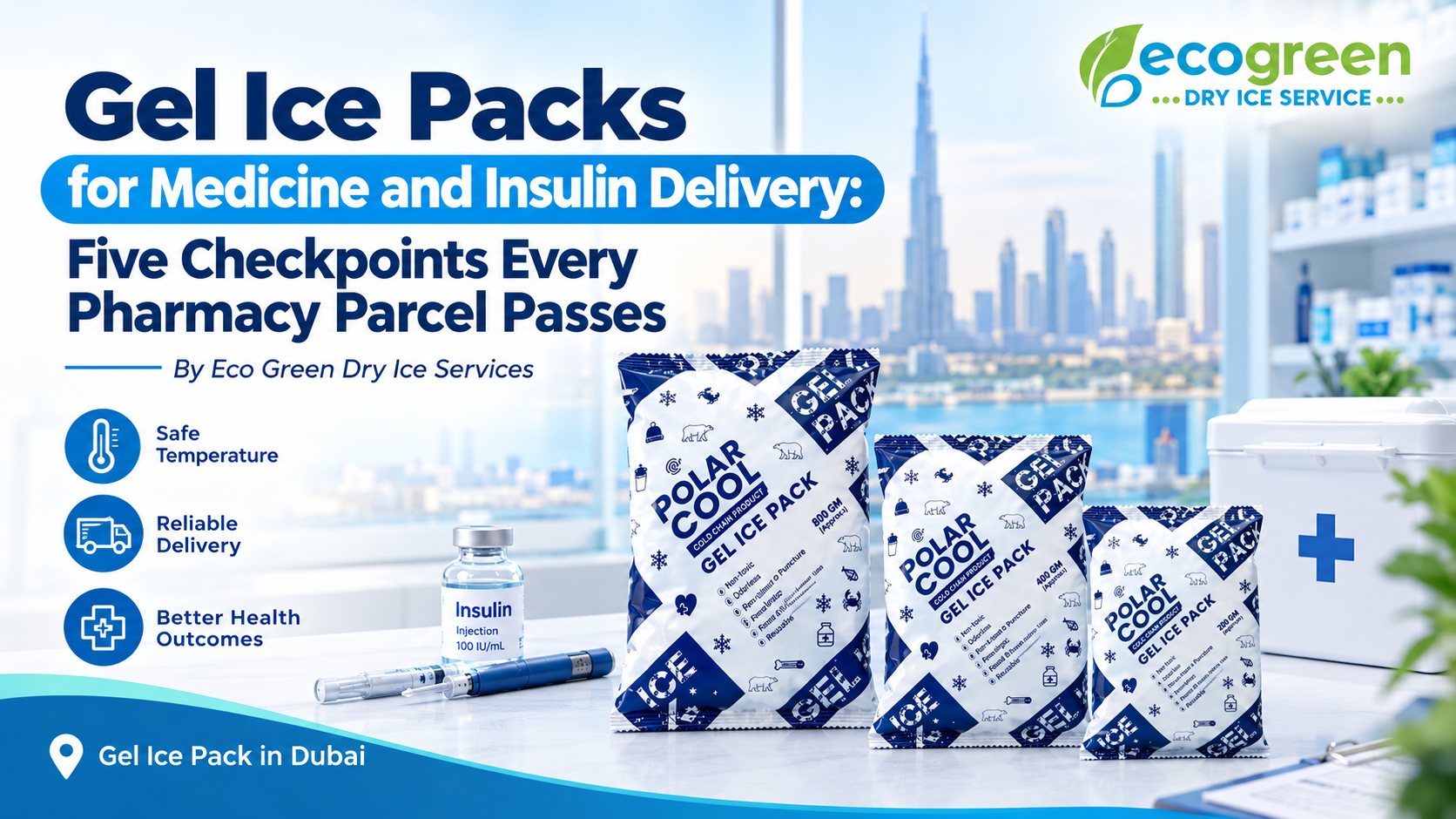
- Gel Ice pack single cell(136 mm * 65mm): compact and rigid, suited to one pen or vial box.
- Gel Ice pack 12 cells: flexes along its seams, so it works under a tray or up the side of a mixed order.
- Gel Ice pack 24 cells: more gel and wider coverage for bulk transfers between branches or clinics.
Checkpoint 4: On the road
This is the longest and least controllable stretch, so plan for the worst case rather than the average one.
- A parked van or a rider’s top box can get hot very quickly in the UAE summer.
- Waiting at a building entrance, a lift or a security desk adds minutes the route plan didn’t count.
- Never leave a medicine parcel in a parked vehicle, even briefly.
A good habit is to write the dispatch time on the parcel. It gives the customer, and your own team, a clear idea of how long it has been travelling.
Checkpoint 5: Handover and the first hour at home
The parcel’s job isn’t done at the door. Tell the customer, in a short note or a line from the rider:
- Put the medicine in the fridge straight away, away from the freezer compartment.
- Check the product against the leaflet. Opened or in-use pens are often kept at room temperature, not in the fridge, so the leaflet decides.
- If anything looks frozen, or the parcel was left out for a long time, call the pharmacy before using it.
This one note prevents more problems than most packaging upgrades.
Prove it with one logged test
Checklists tell you what to do. A logger tells you whether it worked. Put a small temperature logger or digital thermometer inside a test parcel, pack it exactly the way you normally would, and send it down a real route on a hot day. Record the start temperature, box and pack type, route time, and the lowest and highest readings.
If it dips under 2 °C or climbs over 8 °C, change one thing and run it again. It’s usually the barrier, the number of packs, or the waiting time.
When a gel pack isn’t enough
Vaccines, biologics, clinical samples and long-distance shipments often need validated packaging and documented temperature records. In those cases a gel ice pack is one part of a larger system, and your quality or regulatory team should lead. For routine local deliveries of refrigerated medicine, the checkpoints above are a practical starting point.
Frequently asked questions
Can I put a frozen gel pack directly next to insulin?
It’s best not to. A frozen pack can cool the surface of a medicine box below the safe range. Use a barrier layer and check your setup with a thermometer.
What temperature should refrigerated medicine stay at?
Many refrigerated medicines, including most unopened insulin, are labelled for 2–8 °C. Always follow the label on the actual product.
Is a gel ice pack enough for vaccines?
Usually not on its own. Vaccines normally need validated cold-chain packaging and records, so check with your quality or regulatory team.
Which pack is best for one pen or vial?
A Gel Ice pack single cell(136 mm * 65mm) suits small parcels. For mixed orders, Gel Ice pack 12 cells are more flexible.
Do you supply gel ice packs in Dubai?
Yes. If you need a gel ice pack in Dubai, we deliver across Dubai and Abu Dhabi, and you can collect from our Mussafah warehouse. Single and bulk orders are both welcome.
Talk to us about your delivery setup
Looking for a gel ice pack in Dubai for your pharmacy? Tell us what you deliver, how far it travels and how long it waits before handover. We’ll suggest a pack format and quantity, and help you plan a simple test before you roll it out. Reach Eco Green Dry Ice Services on WhatsApp or by phone.